
Home / Books / Parenting Empires

Parenting Empires

Class, Whiteness, and the Moral Economy of Privilege in Latin America
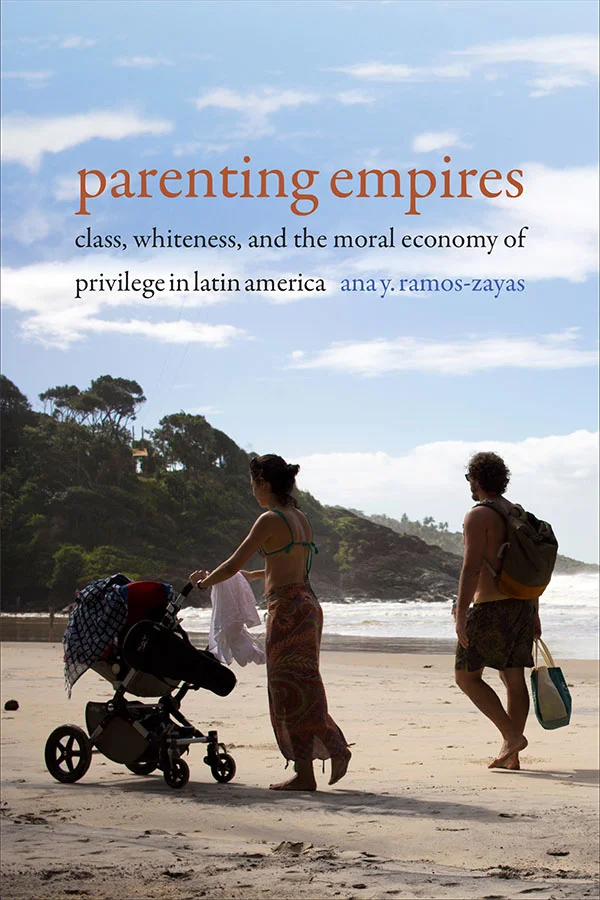
Book

Pages: 296

Illustrations: 13 illustrations

Published: March 2020

In Parenting Empires, Ana Y. Ramos-Zayas focuses on the parenting practices of Latin American urban elites to analyze how everyday experiences of whiteness, privilege, and inequality reinforce national and hemispheric idioms of anti-corruption and austerity. Ramos-Zayas shows that for upper-class residents in the affluent neighborhoods of Ipanema (Rio de Janeiro) and El Condado (San Juan), parenting is particularly effective in providing moral grounding for neoliberal projects that disadvantage the overwhelmingly poor and racialized people who care for and teach their children. Wealthy parents in Ipanema and El Condado cultivate a liberal cosmopolitanism by living in multicultural city neighborhoods rather than gated suburban communities. Yet as Ramos-Zayas reveals, their parenting strategies, which stress spirituality, empathy, and equality, allow them to preserve and reproduce their white privilege. Defining this moral economy as “parenting empires,” she sheds light on how child-rearing practices permit urban elites in the Global South to sustain and profit from entrenched social and racial hierarchies.

Praise

“In this brilliant ethnography, Ana Y. Ramos-Zayas invites us into the intimate worlds of parents and children in two affluent enclaves to listen carefully to conversations about ordinary things: nature, yoga, Eastern spirituality, mindfulness, government corruption, austerity, and sovereignty. She astutely and sensitively shows us how to read the mundane worlds of childrearing as imperial formations that are recasting hierarchies of race and class in very unequal societies under the shadow of U.S. empire.” - Laura Briggs, author of Reproducing Empire: Race, Sex, Science, and U.S. Imperialism in Puerto Rico

“This ambitious and fascinating book connects the interior lives, affects, and childrearing practices of urban elites in Brazil and Puerto Rico to their spatial environments, interpersonal relationships, and national and international political and discursive contexts. Based on rich ethnography in an understudied field, Parenting Empires makes a strong contribution to research on elites and will be of interest to people working on a broad range of issues from class, race, and identity to parenting, urban studies, and development.” - Rachel Sherman, author of Uneasy Street: The Anxieties of Affluence

"This book makes a significant contribution to various aspects of Latin American studies, reproductive sociology, critical whiteness studies and critical race theory, to name only a few." - R. Sánchez-Rivera, Patterns of Prejudice

"Parenting Empires reveals that a strategy for governability in subject populations is to cultivate the imperial core's likeness in them, or at least in the key elite. I recommend this high-end science for students and scholars of social/racial stratification, political economy, and Latin Americanists of all stripes." - Stanley Bailey, American Journal of Sociology

“Agile, informed, and engaging prose.... Where Parenting Empires reveals itself as a trail-blazing text within critical race studies in Latin America is in the author’s knack for picking up, and keenly reflecting, on the anxiety and uncertainty that sit at the root of white identities.” - Guillermo Rebollo Gil, CENTRO

"Brimming over with insightful analyses, memorable fieldwork, and instigating arguments, Parenting Empires is a pathbreaking monograph on the workings of race and class privilege among Latin American upper classes." - Maureen E. O'Dougherty, Anthropos

"This is an ethnography that adds to current literature on Latin America analyzing the rise of the far right by turning to the ways in which the elite justify white privilege and the implementation of austerity measures in the continent through ideas around parenting. It also provides a critical analysis of upper-class parents and their everyday lives, demonstrating how moral ideas about child-rearing and consumption are utilized to justify and solidify deep seeded racial, gendered, and class inequality in both Puerto Rico and Brazil." - Juliana B. Valente, Anthropology Book Forum

"Parenting Empires thus examines how a concrete neoliberal parenting subjectivity promotes peculiar forms of aspirations, languages, scientific narratives, and an emphasis on spiritual cultivation that morally underpinned an imperial expansion. This book demonstrates how ideas about morality and austerity practices turn extreme wealth and racial inequalities into deserving and legitimate privilege conditions." - Hugo Ceron-Anaya, Journal of Latin American Caribbean Anthropology

Buy

Availability: Loading...

Price: Loading...

Request a desk or exam copy Spring 2026 Web Sale

Information

Author/Editor Bios

Back to Top
Ana Y. Ramos-Zayas is Professor of American Studies; Ethnicity, Race, and Migration; and Women, Gender, and Sexuality Studies at Yale University and author of Street Therapists: Race, Affect, and Neoliberal Personhood in Latino Newark and National Performances: The Politics of Class, Race, and Space in Puerto Rican Chicago.

Table Of Contents

Back to Top
Acknowledgments  ix
1. Parenting Empires and the Moral Economy of Privilege in Brazil and Puerto Rico  1
2. The Feel of Ipanema: Social History and Structure of Feeling in Rio de Janeiro  37
3. Parenting El Condado: Social History and Immaterial Materiality in San Juan  65
4. Whiteness from Within: Elite Interiority, Personhood, and Parenthood  95
5. Schooling Whiteness: Adult Friendships, Social Ease, and the Privilege of Choosing Race  127
6. The Extended Family: Intimate Hierarchies and Ancestral Imaginaries  157
7. Affective Inequalities: Childcare Workers and Elite Consumptions of Blackness  185
Epilogue  215
Notes  231
References  261
Index  277

Rights

Back to Top

Sales/Territorial Rights: World

Rights and licensing

Additional Information

Back to Top
Paper ISBN: 978-1-4780-0821-7 / Hardcover ISBN: 978-1-4780-0774-6 / eISBN: 978-1-4780-0925-2 / DOI: https://doi.org/10.1215/9781478009252