
Home / Books / Remaindered Life

Remaindered Life

Book

Pages: 456

Illustrations: 26 illustrations

Published: July 2022

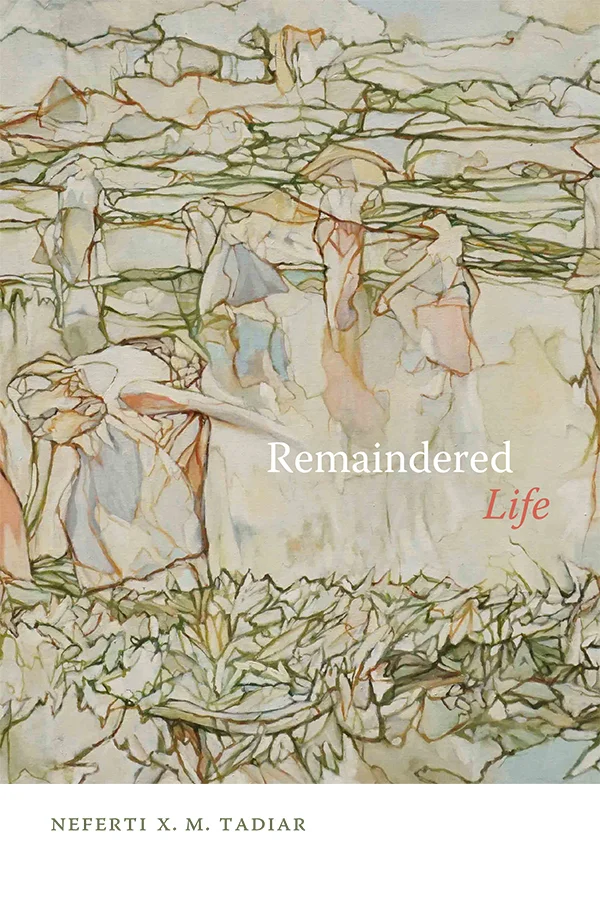
In Remaindered Life Neferti X. M. Tadiar offers a new conceptual vocabulary and framework for rethinking the dynamics of a global capitalism maintained through permanent imperial war. Tracking how contemporary capitalist accumulation depends on producing life-times of disposability, Tadiar focuses on what she terms remaindered life—practices of living that exceed the distinction between life worth living and life worth expending. Through this heuristic, Tadiar reinterprets the global significance and genealogy of the surplus life-making practices of migrant domestic and service workers, refugees fleeing wars and environmental disasters, criminalized communities, urban slum dwellers, and dispossessed Indigenous people. She also examines artists and filmmakers in the Global South who render forms of various living in the midst of disposability. Retelling the story of globalization from the side of those who reach beyond dominant protocols of living, Tadiar demonstrates how attending to remaindered life can open up another horizon of possibility for a radical remaking of our present global mode of life.

Praise

“In this beautiful, elegant, and important book, Neferti X. M. Tadiar addresses the brutality and despair of our current global political economic moment while gesturing to something beyond it in a nonheroic, elegiac way that pays deep respect to those whose lives are remaindered. A chilling and convincing analysis of political economy from one of the standout theorists of our time, Remaindered Life makes far-reaching and significant contributions to big debates about capitalism and contemporary politics.” - Geraldine Pratt, author of Families Apart: Migrant Mothers and the Conflicts of Labor and Love

“Neferti X. M. Tadiar incisively renders the world of the poor, the migrant, the imprisoned, and the expendable in ways that honor both the dire straits they find themselves in and their attempts to create a space to live in that cannot be fully grasped by capitalist valuation. Considering what happens when citizenship is no longer possible, Tadiar offers critical interventions on which to organize reflections on value, dispossession, expendability, sovereignty, and privilege. She pulls no punches in this driven and important book.” - AbdouMaliq Simone, author of The Surrounds: Urban Life Within and Beyond Capture

"A comprehensive, imaginative and carefully compiled account of the interstices of power and its workings at fractal and transnational scales . . . compelling not only for exposing the brutality of our current global political economy but also for doing justice to the complexities of moving beyond it." - Helen Mackreath, LSE Review of Books

"This new work of Marxist-feminism from the Global South is quite simply the most convincing analysis of the current conjuncture I have read. . . . For me, the most important aspect of this book is its righteous ferocity—no injustice can hide from Tadiar’s circumspection." - Mark Driscoll, positions

"This stunningly brilliant book will break your brain and open your mind. Tadiar focuses on the life-making practices of migrant domestic and service workers, refugees, criminalized communities and dispossessed indigenous people to develop a theory of the surplus-making work of global capitalism. She adds a consideration of Global South artists and filmmakers to illuminate the ways of living that offer new possibilities." - Lisa Duggan, Commie Pinko Queer newsletter

"Remaindered Life is well worth a careful read. It is, in fact, a landmark work that provides a rich conceptual arsenal for understanding the capitalism of our times, where the periphery has become the center, where capital is intensifying the violent extraction and accumulation of value from surplus lives that belong to communities that, from its very beginnings in the colonial era, were forcibly subjugated by capitalism." - Walden Bello, Journal of Peasant Studies

"Like other works of Tadiar, this book is theoretically rich and dense and uses the Philippines’ political, historical, and artistic landscapes as sites and material for theorizing about global processes. For scholars interested in the Philippines and its relationship to global forces, the book has much to offer." - Megan Thomas, Journal of Asian Studies

"Remaindered Life is a challenging book. By turns lyrical and blunt, hopeful and outraged, densely theoretical and simply descriptive, it is a text that requires a mode of careful and generous attention. In this sense, it refuses the kind of instrumentalist reading that remaindered life itself resists. It marks an important contribution for scholars and students of critical race studies, feminist social theory, transnational American studies, and cultural studies—as well as a necessary reminder to us all that 'when we carefully tend to our shared being and living, we find more, and then some.'"
  - Iana W. Robitaille, E3W Review of Books

"Remaindered Life is essential reading for those interested in understanding global capitalism through a human lens and those looking for a postcolonial feminist approach to sowing hope through possibility and envisioning alternative, radical futures in a post-capitalist world." - Camille Carter, Hypatia

"Overall this is an important book in terms of identifying new class formations in the contemporary era. . . . [T]he value of the book is how it sketches the outlines of a world system and the responses to it through a lens that centres humanity. Yet this is not a book that calls for human rights, at least in the sense of states granting on citizen subjects; instead, it’s a book that traces an early anthropology of an under-reported war to be human." - Ewan Cameron, IIAS Review

"Casting the global present as both the aftermath and perdurance of decolonization, Neferti X. M. Tadiar’s Remaindered Life offers a profound and timely intervention on modes of life-making and survival, and the concepts of disposability, waste, and value. . . . Simultaneously, it is a book about survival and life-making, and a book about dispossession and life-taking – written in a deeply theoretical and yet also poetic form." - Laura Antona, Journal of Development Studies

Buy

Availability: In stock

Price: $31.95

Request a desk or exam copy

Information

Author/Editor Bios

Back to Top
Neferti X. M. Tadiar is Professor of Women’s, Gender, and Sexuality Studies at Barnard College, Columbia University, author of Things Fall Away: Philippine Historical Experience and the Makings of Globalization, also published by Duke University Press, and Fantasy-Production: Sexual Economies and Other Philippine Consequences for the New World Order.

Table Of Contents

Back to Top
Preface: What This Book Is About  ix
Acknowledgments  xix
Part I: In a Time of War
1. The War to Be Human: Value  3
2. A Global Enterprise: Waste  23
3. Becoming-Human in a Time of War: Remainder  49
Interregnum  73
Part II: Life-Times
4. Of Labor and Fate Playing  87
5. Of Disposability  109
6. Of Survival  123
Part III: Globopolis
7. City Everywhere  141
Excursus  173
Part IV: Dead Exchanges
8. Powers of Defending Freedom  199
9. Powers of Expending Life  229
10. Live Borrowings, Living Connections  257
Thresholds  279
Part V: By the Waysides
11. Bypass and Spendor  301
12. And Then Some  329
Notes  335
Bibliography  387
Index  411

Rights

Back to Top

Sales/Territorial Rights: World

Rights and licensing

Awards

Back to Top

Winner of the 2023 John Hope Franklin Book Prize, presented by the American Studies Association