
Home / Books / Revolution Squared

Revolution Squared

Tahrir, Political Possibilities, and Counterrevolution in Egypt
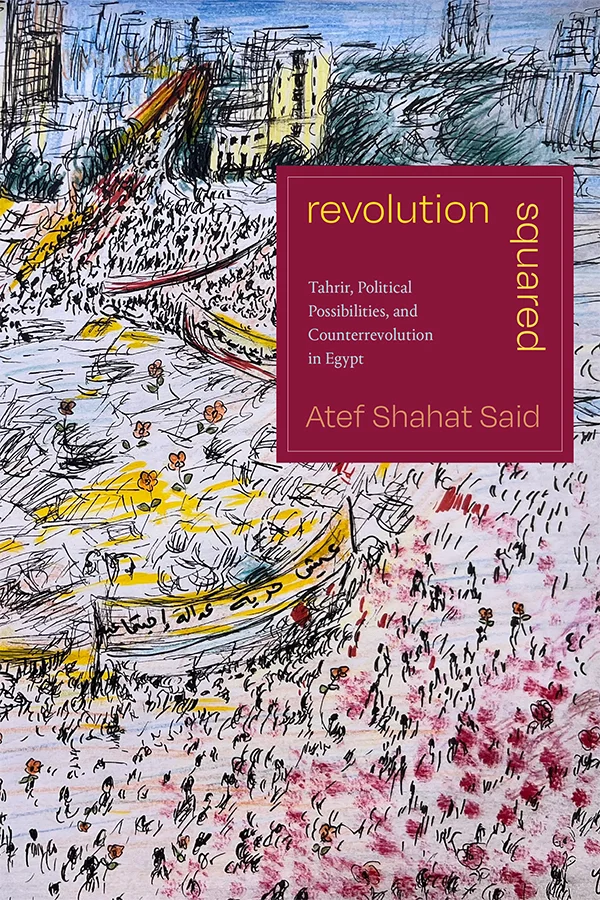
Book

Pages: 360

Illustrations: 15 illustrations

Published: December 2023

In Revolution Squared Atef Shahat Said examines the 2011 Egyptian Revolution to trace the expansive range of liberatory possibilities and containment at the heart of every revolution. Drawing on historical analysis and his own participation in the revolution, Said outlines the importance of Tahrir Square and other physical spaces as well as the role of social media and digital spaces. He develops the notion of lived contingency—the ways revolutionary actors practice and experience the revolution in terms of the actions they do or do not take—to show how Egyptians made sense of what was possible during the revolution. Said charts the lived contingencies of Egyptian revolutionaries from the decade prior to the revolution’s outbreak to its peak and the so-called transition to democracy to the 2013 military coup into the present. Contrary to retrospective accounts and counterrevolutionary thought, Said argues that the Egyptian Revolution was not doomed to defeat. Rather, he demonstrates that Egyptians did not fully grasp their immense clout and that limited reformist demands reduced the revolution’s potential for transformation.

Praise

Revolution Squared is an exciting book that presents a new and insightful framework for understanding the 2011 uprising in Egypt and its aftermath. Atef Shahat Said’s first-person narratives and astute sociological analysis offer a compelling perspective on the organization and longue durée of the revolutionary process. This is absolutely essential reading for anyone interested in contemporary uprisings, in Egypt and beyond.” - Jessica Winegar, author of Creative Reckonings: The Politics of Art and Culture in Contemporary Egypt

“Atef Shahat Said’s thoughtful book Revolution Squared examines the hopes and disappointments of Egypt’s pro-democracy activists, theorizing revolution and counterrevolution alongside the activists’ own attempts to understand how they succeeded so dramatically in 2011 and were defeated so decisively in 2013.” - Charles Kurzman, Professor of Sociology, University of North Carolina at Chapel Hill

“A truly powerful new study of the Egyptian Revolution. Said’s book is gripping in how it blends his own on-the-ground experience with skilled use of theories of revolution and social protest. Atef’s analysis attends to all the key elements of the revolution: youth, neighborhood committees, workers’ strikes, religious and military leaders, weaving an exceptionally rich account of how the revolution first succeeded, then fell to a military coup. This is an outstanding work that everyone interested in revolutions should read.” - Jack A. Goldstone, Virginia E. and John T. Hazel, Jr., Chair Professor of Public Policy and Eminent Scholar, George Mason University

"The book will be of great value to those interested in the relations among urban protests, democracy, and revolution, as well as those who employ multiple and divergent research methods (covered in appendix 3) to explain multifaceted phenomena." - Dena Qaddumi, American Ethnologist

"Atef Said’s stimulating new book . . . refreshingly sets aside the chicken-or-egg approach to Egypt’s 2011 revolution, centering instead the dualities that characterized it from start (2011) to finish (2013). . . . Revolution Squared may not have all the answers. But it points the way to formulating deeper, more resonant questions." - Mona El-Ghobashy, Middle East Journal

"THE INSIGHTS THAT Atef Shahat Said gained into Egypt’s politics of protest and mobilization — through his work and political activities before he embarked on an academic career — deeply enrich Revolution Squared, a participant-observer account of what is widely called Egypt’s January 25, 2011 revolution. . . . The value of Revolution Squared is not so much its contribution to the debate over whether or not this is an appropriate definition of a revolutionary situation. Rather, Said invites us to follow him as he guides us through the day-to-day struggles among the leftists, Islamists and liberals whose only point of agreement — embraced tactically by the military when its commanders felt there was no better choice — was the removal of President Hosni Mubarak." - Joel Beinin, Against the Current

"Revolution Squared is a call to re-evaluate and enrich our understanding of the Egyptian revolution. It adds to the literature on contentious politics in the Middle East specifically, and social movements theories broadly. It puts forward a more inclusive and comprehensive approach to studying episodes of contention in the region. Its analysis offers a critical framework to study and capture the inherent uncertainties that traditionally characterize social movements." - Nermin Allam, Mobilization

"Said meticulously traces the unfolding of the January 25, 2011 Revolution as a major public and cross-class upheaval aiming to initiate a democratic transition in Egypt. The novelty of this work resides its creative and unprecedented sociological take on the Revolution by depicting it as a series of events where major actors’ interactions with uncertainties, unpredictability, and challenges. ... This study constitutes a breakthrough in social movements theory and revolutions scholarship by filling in missing pieces in the analytical lens examining contentious actions, demands, and revolutions"
  - Shaimma Magued, Contemporary Sociology

"Recommended." - Elizabeth Bishop, Choice

"Revolution Squared offers a superb empirical account of Egypt’s revolution, filled with first-hand observations, insightful research, and novel nuances not seen in other books on the topic. . . . Said has developed some novel theoretical ideas of clear importance and utility to scholars of revolution, and broken new ground in the study of space, time, and contingency in revolutionary processes." - Benjamin Abrams, Perspectives on Politics

Buy

Availability: Loading...

Price: Loading...

Request a desk or exam copy

Information

Author/Editor Bios

Back to Top
Atef Shahat Said is Assistant Professor of Sociology at the University of Illinois at Chicago and the author of two books in Arabic.

Table Of Contents

Back to Top
Note on Transliteration  xii
Acknowledgments  xv
Introduction. Revolution as Lived Contingency  1
1. Prelude to Revolutionary Possibilities: Tahrir and Political Protest in Egypt  31
2. Peak of Revolutionary Possibilities: Squared I: How the Revolution Was “Bound” within Tahrir  57
3. Sovereignty in the Street: Popular Committees, Revolutionary Ambivalence, and Unrealized Power  87
4. The Two Souls of the Egyptian Revolution: Democratic Demands, Radical Strikes  112
5. Waning Revolutionary Possibilities: Squared II: Counterrevolutionary Coercion and Elections without Democratization  147
6. Square Zero: The State, Counterrevolutionary Paranoia, and the Withdrawal of Activists  178
Conclusion: Revolution as Experience  210
Appendix 1. Brief Timeline of the Egyptian Revolution, 2011–2018  227
Appendix 2. A Note on Positionality  231
Appendix 3. Notes on Methods, or How I Conducted Historical Ethnography of a Revolution  235
Appendix 4. Major Political Coalitions in Egypt, 2000–2010  251
Notes  263
References  289
Index  325

Rights

Back to Top

Sales/Territorial Rights: World

Rights and licensing

Awards

Back to Top

Winner of the 2025 Evelyn Shakir Nonfiction Award, presented by the Arab American National Museum

Additional Information

Back to Top
Related Links Paper ISBN: 978-1-4780-2550-4 / Hardcover ISBN: 978-1-4780-2072-1 / eISBN: 978-1-4780-2763-8 / DOI: https://doi.org/10.1215/9781478027638