
Home / Books / Speaking for the People

Speaking for the People

Native Writing and the Question of Political Form
Book

Pages: 320

Published: September 2021

Author: Mark Rifkin

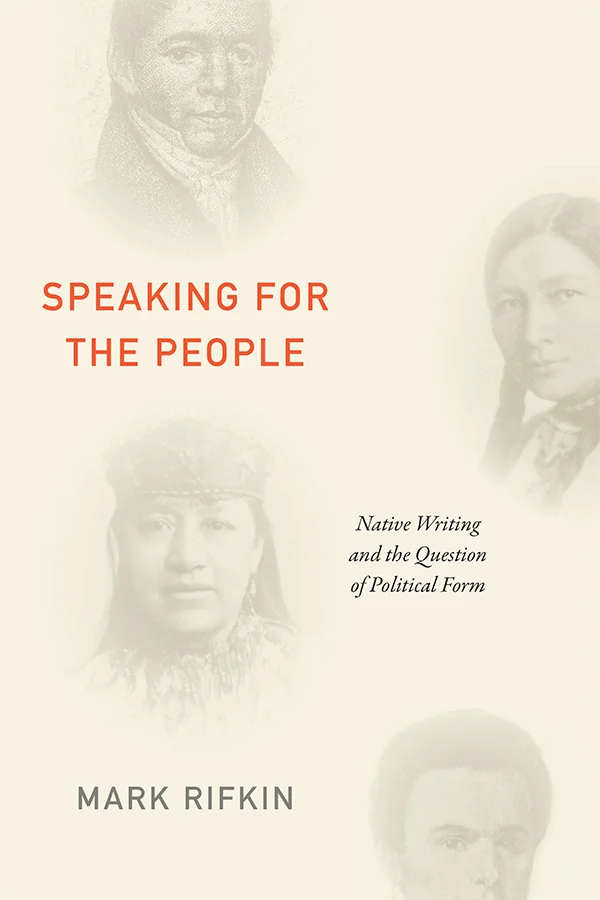
In Speaking for the People Mark Rifkin examines nineteenth-century Native writings to reframe contemporary debates around Indigenous recognition, refusal, and resurgence. Rifkin shows how works by Native authors (William Apess, Elias Boudinot, Sarah Winnemucca, and Zitkala-Ša) illustrate the intellectual labor involved in representing modes of Indigenous political identity and placemaking. These writers highlight the complex processes involved in negotiating the character, contours, and scope of Indigenous sovereignties under ongoing colonial occupation. Rifkin argues that attending to these writers' engagements with non-native publics helps provide further analytical tools for addressing the complexities of Indigenous governance on the ground—both then and now. Thinking about Native peoplehood and politics as a matter of form opens possibilities for addressing the difficult work involved in navigating among varied possibilities for conceptualizing and enacting peoplehood in the context of continuing settler intervention. As Rifkin demonstrates, attending to writings by these Indigenous intellectuals provides ways of understanding Native governance as a matter of deliberation, discussion, and debate, emphasizing the open-ended unfinishedness of self-determination.

Praise

“Mark Rifkin examines important nineteenth-century Native literary figures' engagement with settler publics by laying out a nuanced introspection of their ‘portraits of peoplehood’ during tumultuous contexts and the costs of such representativity that foster tension in the present day. He resituates the discussion of recognition to this earlier period in order to detour from a settler stronghold on political definitions still used to impact the daily life of Indigenous peoples. Delving deep into the political spheres of violence and the nuanced political forms of Indigenous life that emerge, Rifkin gives us further grounds to explore the foundations and formations of slippery recognition politics.” - Mishuana Goeman, Professor of Gender Studies and American Indian Studies, University of California, Los Angeles

“Presenting new, insightful, nuanced, and persuasive readings of four key figures in nineteenth-century Native American literature, Speaking for the People is both timely and poised to become a classic study in Native and Indigenous studies, anthropology, and American literary studies. An interdisciplinary tour de force.” - Birgit Brander Rasmussen, author of Queequeg’s Coffin: Indigenous Literacies and Early American Literature

"Speaking for the People is as useful for scholars and students of contemporary indigenous studies as it is for those pursuing the study of 19th-century literature, politics, and indigenous peoples. Highly recommended. Upper-division undergraduates through faculty." - J. J. Donahue, Choice

"In Speaking for the People Mark Rifkin contributes to the ongoing critical conversation regarding Indigenous recognition. In richly historicized chapters he questions the process of how Indigenous leaders . . . consciously stage the 'legitimacy of their entry' into the discursive frameworks of coloniality." - Caitlin Simmons, Western American Literature

"Speaking for the People reasserts the usefulness and relevance of literary studies in fashioning Indigenous political theory. Rifkin demonstrates how nineteenth-century Native texts have had to navigate settler worldings to express peoplehood and how their intellectual labor of negotiatedness should inspire present-day scholarship. His demonstration is as compelling as it is unsettling." - Mathilde Louette, Transatlantica

"Speaking for the People . . . is valuable for literary scholars and Indigenous scholars alike to articulate the complexity of Indigenous activism in a settler state." - Alison Russell, New England Quarterly

"Speaking for the People has generated a rich set of coordinates and queries for analyzing nineteenth-century Native writing, and Rifkin’s readings model how these questions take us deep into nineteenth-century Native political discussions while resonating in contemporary NAIS scholarship." - Kelly Wisecup, Native American and Indigenous Studies

"One of the book’s valuable through-lines is its interest in looking to the past as a means to think about contemporary Indigenous resurgence. . . . Through Rifkin’s analyses, we might look at these nineteenth-century authors as exemplifying the many shifting forms that Native self-determination can take." - Hannah Manshel, American Literary History

Buy

Availability: Loading...

Price: Loading...

Request a desk or exam copy

Information

Author/Editor Bios

Back to Top
Mark Rifkin is Professor of English and Women's, Gender, and Sexuality Studies at the University of North Carolina, Greensboro. He is the author of several books, including Fictions of Land and Flesh: Blackness, Indigeneity, Speculation and Beyond Settler Time: Temporal Sovereignty and Indigenous Self-Determination, both also published by Duke University Press.

Table Of Contents

Back to Top
Acknowledgments  vii
Introduction  1
1. What's in a Nation? Cherokee Vanguardism in Elias Boudinot's Letters  35
2. Experiments in Signifying Sovereignty: Exemplarity and the Politics of Southern New England in William Apess  77
3. Among Ghost Dances: Sarah Winnemucca and the Production of Paiute Identity  127
4. The Native Informant Speaks: The Politics of Ethnographic Subjectivity in Zitkala-Ša's Autobiographical Stories  176
Coda. On Refusing the Ethnographic Imaginary, or Reading for the Politics of Peoplehood  221
Notes  235
Bibliography  277
Index  301

Rights

Back to Top

Sales/Territorial Rights: World

Rights and licensing

Additional Information

Back to Top
Paper ISBN: 978-1-4780-1433-1 / Hardcover ISBN: 978-1-4780-1341-9 / eISBN: 978-1-4780-2163-6 / DOI: https://doi.org/10.1215/9781478021636