
Home / Books / Strolling in the Ruins

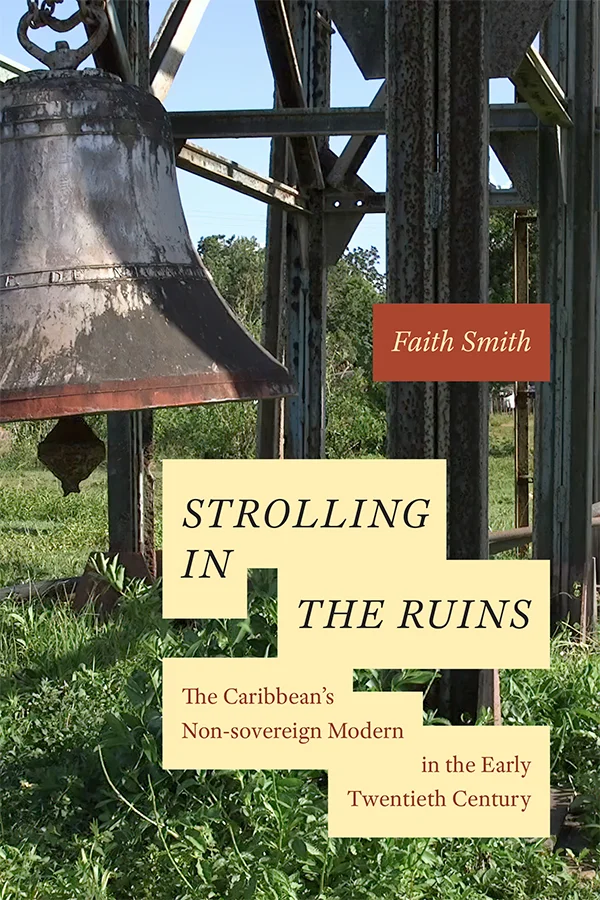
Strolling in the Ruins

The Caribbean’s Non-sovereign Modern in the Early Twentieth Century
Book

Pages: 280

Illustrations: 2 illustrations

Published: March 2023

Author: Faith Smith

In Strolling in the Ruins Faith Smith engages with a period in the history of the Anglophone Caribbean often overlooked as nondescript, quiet, and embarrassingly pro-imperial within the larger narrative of Jamaican and Trinidadian nationalism. Between the 1865 Morant Bay Rebellion and World War I, British imperialism was taken for granted among both elites and ordinary people, while nationalist discourses would not begin to shape political imagination in the West Indies for decades. Smith argues that this moment, far from being uneventful, disrupts the inevitability of nationhood in the mid-twentieth century and anticipates the Caribbean’s present-day relationship to global power. Smith assembles and analyzes a diverse set of texts, from Carnival songs, poems, and novels to newspapers, photographs, and gardens, to examine theoretical and literary-historiographic questions concerning time and temporality, empire and diaspora, immigration and indigeneity, gender and the politics of desire, Africa’s place within Caribbeanist discourse, and the idea of the Caribbean itself. Closely examining these cultural expressions of apparent quiescence, Smith locates the quiet violence of colonial rule and the insistence of colonial subjects on making meaningful lives.

Praise

“Faith Smith’s Strolling in the Ruins seeks to perturb and discompose the pervasive story of Anglophone Caribbean sovereignty, with its familiar rhythms and moments, events and directions, and texts and figures. With an insouciant edge, muted irony, and compelling insight, she invites us to reevaluate some of our most cherished conceits of gendered, sexual, racial, and political citizenship. Above all, Smith is a consummate critic of the will to power of the heroic Caribbean narrative of postcolonial achievement.” - David Scott, Columbia University

“A complex and critically important exploration of Caribbean identity between emancipation and independence, Strolling in the Ruins builds on and transcends contemporary discourse on the centrality of nationalist sovereignty to political life. By taking seriously ordinary people’s commitment to empire and their understanding of their gendered and racialized place within it, Faith Smith brilliantly and innovatively brings the central questions of our political modern into sharp view.” - Deborah A. Thomas, author of Political Life in the Wake of the Plantation: Sovereignty, Witnessing, Repair

"Against the narrative of heroic sovereignty that has dominated Caribbean literary history, Faith Smith suggests the advantages of slowing down, of caution, of waiting, of strolling. . . . [T]his book strolls, too, eschewing any untoward rush to judgment or conclusion, taking its time, exploring side streets and alleyways, emerging onto the main thoroughfare from unexpected directions. It always makes us look anew, look differently. We could not ask for a better guide." - Peter Hulme, New West Indian Guide

Buy

Availability: Loading...

Price: Loading...

Request a desk or exam copy

Information

Author/Editor Bios

Back to Top
Faith Smith is Associate Professor of African and African American Studies and of English at Brandeis University. She is the author of Creole Recitations: John Jacob Thomas and Colonial Formation in the Late Nineteenth-Century Caribbean and editor of Sex and the Citizen: Interrogating the Caribbean.

Table Of Contents

Back to Top
Acknowledgments  ix
Introduction. Introducing a Quiet Period  1
1. Cuba, South Africa, and the Anglophone Caribbean’s New Imperial Century  33
2. Ruination’s Intimate Architecture  68
3. Photography’s “Typical Negro”  118
4. Plotting Inheritance  144
Coda  186
Notes  191
Bibliography  229
Index  257

Rights

Back to Top

Sales/Territorial Rights: World

Rights and licensing

Additional Information

Back to Top
Paper ISBN: 978-1-4780-1968-8 / Hardcover ISBN: 978-1-4780-1704-2 / eISBN: 978-1-4780-2431-6 / DOI: https://doi.org/10.1215/9781478024316