
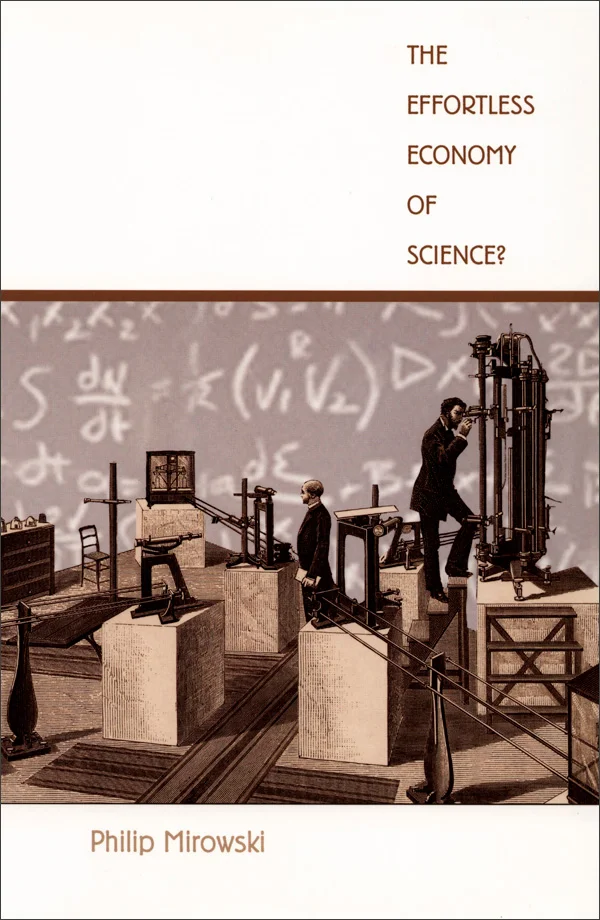
The Effortless Economy of Science?
Science and Cultural Theory
Book
Pages: 472
Illustrations: 9 tables, 1 illus.
Published: July 2004
Author: Philip Mirowski
Praise
Buy
Availability: Loading...
Price: Loading...
This title will be released on July 21, 2004
Buy the e-book:
Information
Author/Editor Bios
Back to TopPhilip Mirowski is Carl Koch Professor of Economics at the University of Notre Dame. Among his books are Machine Dreams: Economics Becomes a Cyborg Science; More Heat Than Light: Economics as Social Physics, Physics as Nature’s Economics; and Science Bought and Sold: Essays in the Economics of Science (coedited with Esther-Mirjam Sent).
Table Of Contents
Back to Top
Part One From Economics to Science Studies 1
Introduction: Cracks, Hidden Passageways, and False Bottoms: The Economics of Science and Social Studies Economics 3
1. Confessions of an Aging Enfant Terrible 37
Part Two Science as an Economic Phenomenon 51
2. On Playing the Economics Card in the Philosophy of Science: Why It Didn’t Work for Michael Polanyi 53
3. Economics, Science, and Knowledge: Polanyi versus Hayek 72
4. What’s Kuhn Got to Do with It? 85
5. The Economic Consequences of Philip Kitcher 97
6. Re-engineering Scientific Credit in the Era of Globalized Information Economy 116
Part Three Rigorous Quantitative Measurement as a Social Phenomenon 145
7. Looking for Those Natural Numbers: Dimensionless Constants and the Idea of Natural Measurement 147
8. A Visible Hand in the Marketplace of Ideas: Precision Measurement as Arbitrage 169
Part Four Is Econometrics an Empirical Endeavor? 193
9. Brewing, Betting, and Rationality in London, 1822-1844: What Econometrics Can and Cannot Tell Us about Historical Actors 195
10. Why Econometricians Don’t Replicate (Although They Do Reproduce) 213
11. From Mandlebrot to Chaos in Economic Theory 229
12. Mandelbrot’s Economics after a Quarter-Century 251
13. The Collected Economic Works of William Thomas Thornton: An Introduction and Justification 273
14. Smooth Operator: How Marshall’s Demand and Supply-Curves Made Neoclassicism Safe for Public Consumption but Unfit for Science 335
15. Problems in the Paternity of Econometrics: Harry Ludwell Moore 357
16. Refusing the Gift 376
Notes 401
References 427
Index 459
Introduction: Cracks, Hidden Passageways, and False Bottoms: The Economics of Science and Social Studies Economics 3
1. Confessions of an Aging Enfant Terrible 37
Part Two Science as an Economic Phenomenon 51
2. On Playing the Economics Card in the Philosophy of Science: Why It Didn’t Work for Michael Polanyi 53
3. Economics, Science, and Knowledge: Polanyi versus Hayek 72
4. What’s Kuhn Got to Do with It? 85
5. The Economic Consequences of Philip Kitcher 97
6. Re-engineering Scientific Credit in the Era of Globalized Information Economy 116
Part Three Rigorous Quantitative Measurement as a Social Phenomenon 145
7. Looking for Those Natural Numbers: Dimensionless Constants and the Idea of Natural Measurement 147
8. A Visible Hand in the Marketplace of Ideas: Precision Measurement as Arbitrage 169
Part Four Is Econometrics an Empirical Endeavor? 193
9. Brewing, Betting, and Rationality in London, 1822-1844: What Econometrics Can and Cannot Tell Us about Historical Actors 195
10. Why Econometricians Don’t Replicate (Although They Do Reproduce) 213
11. From Mandlebrot to Chaos in Economic Theory 229
12. Mandelbrot’s Economics after a Quarter-Century 251
13. The Collected Economic Works of William Thomas Thornton: An Introduction and Justification 273
14. Smooth Operator: How Marshall’s Demand and Supply-Curves Made Neoclassicism Safe for Public Consumption but Unfit for Science 335
15. Problems in the Paternity of Econometrics: Harry Ludwell Moore 357
16. Refusing the Gift 376
Notes 401
References 427
Index 459
Rights
Back to TopSales/Territorial Rights: World
Rights and licensingAdditional Information
Back to Top
Paper ISBN:
978-0-8223-3322-7 /
Hardcover ISBN:
978-0-8223-3310-4 /
eISBN:
978-0-8223-8564-6 /
DOI:
https://doi.org/10.1215/9780822385646
Publicity material