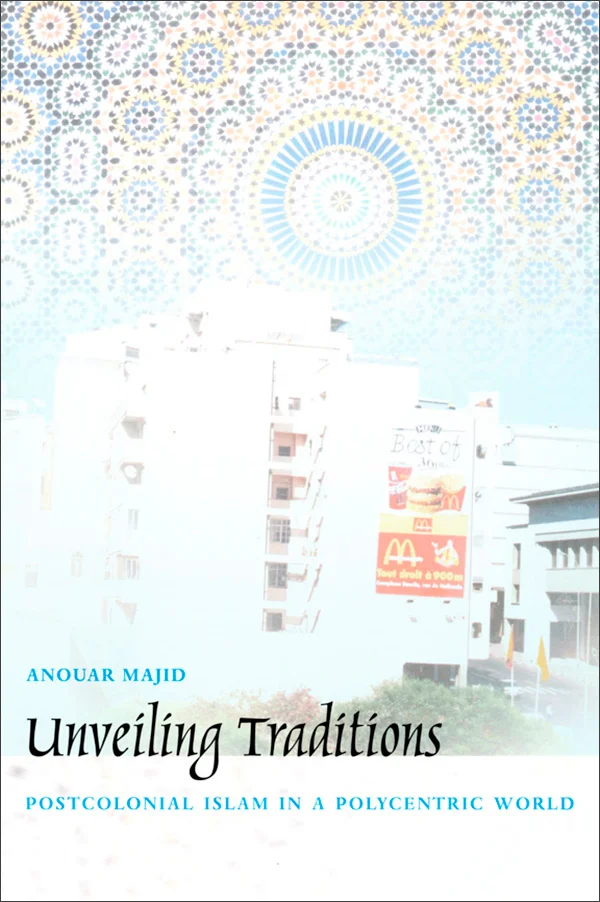
“[Unveiling Traditions] draws upon an impressive range of scholarship, from literary, cultural, and social theory to history, theology, and journalism. Learned, lucid, and compelling, it poses a considerable challenge to scholars in a number of fields to reexamine some of their basic assumptions about modernity . . . .” - Waïl S. Hassan , Jouvert
“[A] fascinating, eloquent, and highly readable book . . . . “ - Valentine M. Moghadam , Middle East Journal
“[A] superb text. . . .a must read.” - Cornel West , Democracy Matters
“Although this project seems shocking in its enormity, Majid’s lack of pessimism coupled with his intellectual acumen transforms an argument that initially appears to be romantic utopianism into the most fascinating aspect of the text. Everything about Unveiling Traditions breaks from the norms of contemporary theoretical discourse. . . . [T]he text offers useful literary analysis. . . . Majid writes with a unique passion and sense of purspose. Unveiling Traditions is an exciting and enlightening read. Rarely does a theoretical text read as fluidly as a novel, but Majid accomplishes exactly that. The study of literature and world affairs will be significantly advanced if this book manages to set new trends.” - Steven Salaita , Genre
“In his analysis of the deculturing effects of globalization, reactionary Arab and Muslim nationalism, and Western critical theory, Majid reminds his readers that theories are indeed moral expressions. His polycentric paradigm of progressive, self-critical cultures engaging with each other is a welcome ethical alternative to the unipolar world being crafted by American economic interests.” - Pamela Nice , Al Jadid
“Majid’s Unveiling Traditions could not be more timely, appearing almost prophetically as a voice of both urgency and moderation in its vision of a progressivist Islam.” - Eleanor Kaufman , Interventions
“Majid’s polycentric paradigm of progressive, self-critical cultures engaging with each other is a welcome alternative to the “clash of civilization” uproar that dominates American discourses in a post 9-11 world. The book is in general very thorough in its examination of the issues. The arguments are made brilliantly.” - Parvez Ahmed , Journal of Commonwealth and Postcolonial Studies
"[A] telling analysis of the current situation, regardless of to which camp one belongs, and the book is a welcome addition to the progressive voice of Islam. . . . Postcolonial analyses raise important questions about hegemony and power, and Majid's work is a significant contribution to the discussion. He succeeds in opening up questions with which scholars, policy-makers and intercultural researches should be conversant. And it is certainly reassuring to hear a liberal voice among Muslim scholars amid the plethora of other, less convincing types. This in itself is a kind of unveiling." - Earle Waugh, Journal of International Migration and Integration
"[B]rilliantly developed. . . . Majid . . . has written a masterful and passionate work that challenges readers . . . to truly ponder why Western values and social and political institutions should come to dominate the rest of the world. . . . [Majid] puts forward an incredibly sharp critique of the effects of capitalistic hegemony on the global community." - Rebecca Torstrick , NWSA Journal
"[Majid’s] provocative discussion of the Salman Rushdie affair and his assessment of Muslim feminist scholarship richly contribute to these two ongoing debates. In brief, Unveiiling Traditions is a passionately argued, academically grounded work about the ongoing crisis of Muslim societies faced with new global realities engendered by world capitalism and the cultural hegemony of the West." - Amal Rassam , American Anthropologist
"Majid attempts, successfully, to put Islamic studies and postcolonial theory in conversation. . . . Unveiling Tradition is a stimulating read that will be of special interest to Islamicist and scholars of postcolonial societies. Recommended." - Omid Safi , Religious Studies Review
“An important book. Coming from a different intellectual perspective, Majid qualifies and expands the ordinary terms of postcolonial discourse and he does so from a genuinely international intellectual position. There are few academics writing today who draw on the cultural and literary range that Majid does here.” - Leila N. Ahmed, author of Women and Gender in Islam
“This excellent book is full of passionate, polemical scholarship. Majid covers a wide-ranging territory—the persistence of ‘orientalist’ discourse, ‘Arab’ nationalism, ‘Islamic fundamentalism,’ postcolonial criticism, a critique of capitalism, contemporary Muslim feminist scholarship, and (black) African novels from Islamic cultural backgrounds. This timely book will make a significant contribution to current debates about progressive social, political, and cultural directions.” - Abdul JanMohamed, University of California, Berkeley