
Home / Books / Why We Can′t Have Nice Things

Why We Can′t Have Nice Things

Social Media’s Influence on Fashion, Ethics, and Property
Book

Pages: 176

Illustrations: 15 illustrations

Published: September 2022

Author: Minh-Ha T. Pham

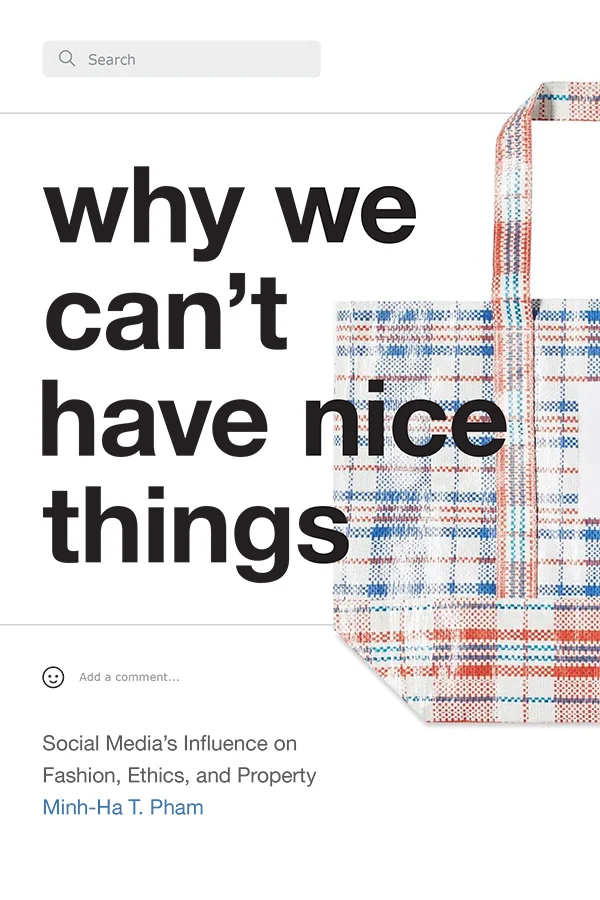
In 2016, social media users in Thailand called out the Paris-based luxury fashion house Balenciaga for copying the popular Thai “rainbow bag,” using Balenciaga’s hashtags to circulate memes revealing the source of the bags’ design. In Why We Can’t Have Nice Things Minh-Ha T. Pham examines the way social media users monitor the fashion market for the appearance of knockoff fashion, design theft, and plagiarism. Tracing the history of fashion antipiracy efforts back to the 1930s, she foregrounds the work of policing that has been tacitly outsourced to social media. Despite the social media concern for ethical fashion and consumption and the good intentions behind design policing, Pham shows that it has ironically deepened forms of social and market inequality, as it relies on and reinforces racist and colonial norms and ideas about what constitutes copying and what counts as creativity. These struggles over ethical fashion and intellectual property, Pham demonstrates, constitute deeper struggles over the colonial legacies of cultural property in digital and global economies.

Praise

“What are social media users doing when they join in crowdsourced digital outrage against fashion copycatting? Staging an urgent and essential conversation among critical race, intellectual property, digital labor, and global fashion scholars, Minh-Ha T. Pham reveals what is at stake within struggles over fashion creativity and impropriety. She tracks the new ethics of consumer social responsibility and routines of casualized and hyper-visible digital labor that work to reproduce white Western standards of fashion ethics, taste, and intellectual property.” - Roopali Mukherjee, author of The Racial Order of Things: Cultural Imaginaries of the Post-Soul Era

“Minh-Ha T. Pham has written the first definitive sociological account of ‘crowdsourced IP regulation’—that is, the mostly unpaid labor of fashion blogs and social media accounts in policing fashion knockoffs. Pham’s book immerses us in a new world of volunteer regulators scouring the internet for evidence of copying, calling out what they perceive as ‘fake’ (often without regard to whether the copies are illegal or not), and, whether intentionally or otherwise, reinforcing elite luxury brands’ stranglehold on fashion innovation.” - Christopher Sprigman, coauthor of The Knockoff Economy: How Imitation Sparks Innovation

"Pham’s work offers a thorough look at how online behavior is shaping fashion industry actions and sheds light on the ways the current norms are failing some communities while granting protections to others."
  - Sarah Bartlett Schroeder, Library Journal

"Overall, in this book Minh-Ha T. Pham makes an important and unique contribution to the fields of media studies and critical race studies. The book will prove informative for scholars and students of these subjects and for those interested in the Thai or Vietnamese fashion industries and commerce as well as social media activism." - Sandra Kurfürst, Journal of Asian Studies

"Will poor taste ever go out of fashion? Find out now. Get yourself a copy of this book today." - Jane M. Ferguson, Sojourn

"Pham’s excellent discussion of social media users’ regulatory actions related to fashion copies is essential reading for those interested in fashion ethics. She challenges prevailing ideas around fashion inspiration and appropriation and provides a background of fashion knockoffs to illustrate how these ideas are based in racist and colonial histories. Her detailed discussion of Asian stereotypes is critical for understanding contemporary bias regarding fashion copies and her case studies demonstrate how these are perpetuated through current fashion discourses." - Amy Dorie, Fashion, Style & Popular Culture

"Why We Can’t Have Nice Things is a thought-provoking book that challenges readers to rethink the relationship between social media, fashion ethics, and IP regulation. . . . Pham succeeds in illuminating the racialized hierarchies that underpin the fashion industry and the potential pitfalls of crowdsourced regulation." - Erica Tso, H-Material-Culture, H-Net Reviews

Buy

Availability: In stock

Price: $23.95

Request a desk or exam copy

Information

Author/Editor Bios

Back to Top
Minh-Ha T. Pham is Associate Professor in the Graduate Program in Media Studies at the Pratt Institute and author of Asians Wear Clothes on the Internet: Race, Gender, and the Work of Personal Style Blogging, also published by Duke University Press.

Table Of Contents

Back to Top
Acknowledgments  vii
Introduction. “Share This with Your Friends”: Crowdsourcing IP Regulation  1
1. Regulating Fashion IP, Regulating Difference  27
2. The Asian Fashion Copycat  53
3. How Thai Social Media Users Made Balenciaga Pay for Copying the Sampeng Bag  77
4. “Ppl Knocking Each Other off Lol”: Diet Prada’s Politics of Refusal  99
Epilogue. Why We Can't Have Nice Things  125
Notes  131
Bibliography 147
Index  165

Rights

Back to Top

Sales/Territorial Rights: World

Rights and licensing

Additional Information

Back to Top
Related Links Paper ISBN: 978-1-4780-1861-2 / Hardcover ISBN: 978-1-4780-1598-7 / eISBN: 978-1-4780-2321-0 / DOI: https://doi.org/10.1215/9781478023210